
Home › Education › Fire Risk Assessment School
Fire Risk Assessment for Schools — Generated Instantly for £29
Describe your school premises — building age, pupil numbers, layout, fire safety measures already in place. We generate a fully written, UK-compliant fire risk assessment meeting the Regulatory Reform (Fire Safety) Order 2005 in minutes.
Used by headteachers, academy trusts, MATs, school business managers and facilities teams across the UK

🔥 Multi-storey school with sleeping accommodation (boarding)? Mention it — we'll include enhanced fire separation, travel distances, night-time evacuation procedures and the specific duties under Article 8 of the Fire Safety Order applicable to sleeping accommodation.
Legal requirements for fire risk assessments in schools
Under the Regulatory Reform (Fire Safety) Order 2005, every school in England and Wales must carry out a suitable and sufficient fire risk assessment. Article 9(1) requires the responsible person (typically the headteacher, governing body or academy trust) to conduct a fire risk assessment and implement appropriate fire precautions. The assessment must be recorded if the school employs five or more people or if it is a licensed premises, which effectively means all schools must record it in writing.
In Scotland, the Fire (Scotland) Act 2005 and Fire Safety (Scotland) Regulations 2006 impose the same duty. Northern Ireland schools are covered by the Fire and Rescue Services (Northern Ireland) Order 2006. All four UK nations require a documented fire risk assessment for educational premises.
Schools with sleeping accommodation — boarding schools, residential special schools — fall under Article 8 of the Fire Safety Order, which imposes additional requirements for fire detection, emergency lighting and escape route provision. Department for Education guidance Fire Safety in New and Existing School Buildings (2018) and Managing School Premises (2024) set out best practice, including annual fire drills, staff training and emergency evacuation procedures.
Fire and rescue authorities conduct fire safety inspections under Article 27 of the Fire Safety Order and will request to see a written fire risk assessment. Failure to maintain a suitable assessment is a criminal offence. Prosecution can result in unlimited fines and custodial sentences for responsible persons. In 2019, the HSE and fire services prosecuted several schools following serious fires where inadequate fire risk assessments contributed to dangerous conditions.
How It Works

1. Describe the Premises
Tell us the school type (primary, secondary, special, boarding), building age and construction, number of pupils and staff, floor levels, fire alarm and emergency lighting systems, and any known hazards (e.g. science labs, art rooms, storage of flammable materials). If you have sleeping accommodation or lone workers on site (e.g. night security, boarding staff), mention it.

2. Let the app take the strain
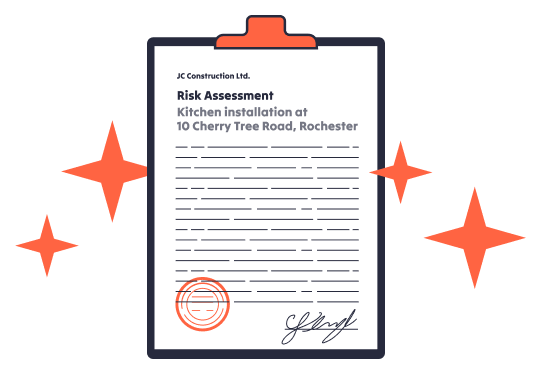
Anyrisks produces a fully written, UK-compliant fire risk assessment referencing the Fire Safety Order 2005, DfE guidance and industry best practice for schools.
3. Instant Download and Use
Download as PDF and Word. Present it to governors, fire inspectors, Ofsted or the local authority. Use it as the basis for your annual review. £29, no subscription, reviewed annually or when significant changes occur.
What It Covers
Every school fire risk assessment is written in full — covering all fire hazards and compliance requirements relevant to your premises.
Fire detection and alarm systems (L1, L2, L3 categories)
Emergency lighting and signage
Means of escape — travel distances, protected routes
Fire doors, self-closers and intumescent seals
Compartmentation and fire separation (especially multi-storey)
Assembly hall, sports hall and dining hall fire safety
Science labs — flammable chemicals, Bunsen burners, fume cupboards
Art and design technology rooms — solvents, kilns, machinery
Storage of flammable materials (paper, cleaning products, LPG cylinders)
Electrical equipment fire risk — chargers, servers, kitchen equipment
Sleeping accommodation fire safety (boarding schools)
Evacuation procedures for pupils with SEND or mobility impairments
Staff fire safety training and frequency requirements
Fire drill frequency and recording obligations
Arson prevention — external waste storage, perimeter security
Regulatory Reform (Fire Safety) Order 2005 compliance
Works For
From village primaries to multi-site academy trusts, Anyrisks covers every type of school and educational setting.
What Customers Say
"As a small primary school we don't have in-house facilities expertise. Anyrisks gave us a compliant fire risk assessment that covered everything from fire doors to our single-storey layout. Fire service was satisfied on inspection."
Helen R.
Headteacher, rural primary school, Cumbria
"We manage a multi-academy trust with nine schools. Anyrisks allowed us to produce tailored fire risk assessments for each site without paying consultants thousands. Every assessment referenced the Fire Safety Order correctly."
James T.
Facilities Manager, MAT, West Midlands
"Our boarding school needed a fire risk assessment covering sleeping accommodation and night-time evacuation. Anyrisks included all the Article 8 requirements — emergency lighting, travel distances, staff duties. Saved us £1,200 on a consultant."
Dr Sarah M.
Deputy Head, independent boarding school, Surrey
Anyrisks vs Fire Safety Consultants
| Anyrisks | Consultant Site Visit | |
|---|---|---|
| Written in full — compliant with Fire Safety Order 2005 | ✓ | ✓ |
| Covers fire detection, means of escape, compartmentation | ✓ | ✓ |
| Boarding school / sleeping accommodation compliance | ✓ | ✓ |
| References DfE guidance and industry standards | ✓ | Sometimes |
| Instant delivery — no site visit scheduling | ✓ | ✗ |
| Editable Word format for annual reviews | ✓ | ✗ |
| Cost | £29 | £600—£2,500 |
| Turnaround time | Under 2 minutes | 2—4 weeks |
Frequently Asked Questions
Is a fire risk assessment a legal requirement for schools?
Yes — Article 9 of the Regulatory Reform (Fire Safety) Order 2005 requires every school to carry out a suitable and sufficient fire risk assessment. The assessment must be recorded in writing. This applies to all schools in England and Wales, with equivalent legislation in Scotland and Northern Ireland.
Who is the responsible person for fire safety in a school?
The responsible person is usually the headteacher, the school's governing body, or the academy trust. In local authority-maintained schools, responsibility may be shared between the governing body and the local authority depending on the building ownership and management arrangements.
Does this assessment cover boarding schools and sleeping accommodation?
Yes — if you describe sleeping accommodation (boarding houses, residential special schools), the assessment will include Article 8 requirements: enhanced fire detection (typically L1 category), emergency lighting to sleeping areas, protected escape routes, and night-time evacuation procedures.
How often must a school fire risk assessment be reviewed?
The Fire Safety Order requires regular review. Department for Education guidance recommends annual reviews as a minimum, or whenever significant changes occur (building alterations, change in pupil numbers, new hazards introduced). Anyrisks assessments are provided in Word format so you can update them each year.
Will this satisfy Ofsted and fire service inspections?
Yes — Anyrisks produces a written fire risk assessment in the format expected by Ofsted inspectors and fire and rescue authorities. The assessment references the Fire Safety Order 2005 and DfE guidance, covers all required hazard categories, and documents your fire precautions clearly.
Does it cover science labs and art rooms?
Yes — mention any specialist teaching areas (science labs, art rooms, design technology workshops) and the assessment will cover fire risks from flammable chemicals, Bunsen burners, kilns, solvents and machinery. COSHH considerations are included where relevant.
Can I use this for a multi-site academy trust?
Yes — generate a separate assessment for each school site. Each site will have unique characteristics (building age, layout, pupil numbers, fire safety systems) and the assessment will be tailored accordingly.
What if we have pupils with SEND or mobility impairments?
Mention this in your description and the assessment will include Personal Emergency Evacuation Plans (PEEPs) considerations, refuge areas, and staff responsibilities for assisting pupils who cannot self-evacuate.
Do you cover fire risk assessments for schools in London and other UK cities?
Yes — Anyrisks generates fire risk assessments for schools anywhere in the UK, including London, Manchester, Birmingham and every other city and region. It's an online generator rather than a local assessor, so there's no firm to find or site visit to book: describe your school's buildings and pupil numbers, and receive a Fire Safety Order-compliant assessment as PDF and Word within minutes.