
Home › Small Business Risk Assessment
Risk Assessments for Small Businesses — Done in 2 Minutes
Every UK employer must have a suitable risk assessment. Get yours done in seconds — professionally formatted, UK health and safety compliant, and ready to share with staff or inspectors.
Used by sole traders, SME owners, and office managers. Covers workplace hazards, DSE, manual handling, fire safety, and more.

How It Works
1. Describe Your Activity
Give us a few details about your small business work or premises. It takes less than a minute.

2. Let the app take the strain
Our advanced algorithms produce a comprehensive, UK-standard risk assessment tailored to your specific situation.
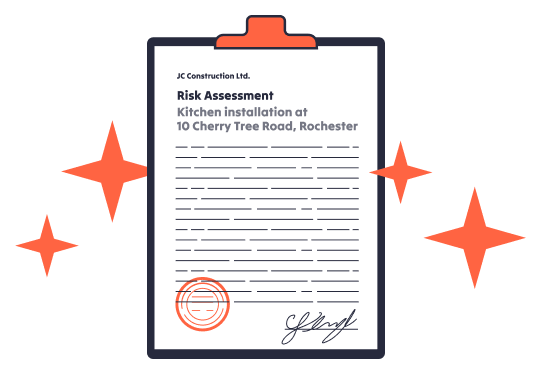
3. Download Instantly
Get a professionally formatted PDF and fully editable Word document, ready to use right away.
What It Covers
Every small business risk assessment is written in full — covering all significant hazards relevant to your premises and activities. HSE data shows slips, trips and falls account for around 30% of reported workplace injuries, and manual handling a further 20%.
- ✓Slips, trips and falls — floor surfaces, trailing cables, wet floors, stairs
- ✓Manual handling — lifting stock, equipment, deliveries
- ✓Display screen equipment (DSE) — workstation setup, eye strain, posture
- ✓Fire safety — means of escape, fire extinguishers, emergency procedures
- ✓Workplace transport — forklifts, pallet trucks, delivery vehicles
- ✓Electrical safety — fixed wiring, portable appliances, overloaded sockets
- ✓Lone working — staff working alone in the building or off-site
- ✓Violence and aggression — dealing with the public, cash handling, night working
- ✓Work-related stress — workload, deadlines, job demands
- ✓COSHH substances — cleaning products, printer toner, adhesives
- ✓Noise exposure — machinery, equipment, open-plan offices
- ✓First aid provision — qualified first aiders, first aid kits, accident reporting
- ✓Pregnancy and new mothers — adjustments to work, manual handling restrictions
- ✓Young workers and work experience placements — supervision, training, restricted tasks
What You Get
- ✓Instant PDF download — ready to share with clients, insurers, or site managers
- ✓Fully editable Word document — adjust anything to suit your needs
- ✓Industry-specific hazards, people at risk, and control measures
- ✓Professionally formatted with risk ratings and action owners
- ✓UK health and safety legislation aligned
- ✓Delighted or your money back within 24 hours
Join thousands of UK businesses getting risk assessments done in minutes.
You’ll be delighted with your Risk Assessment, or your money back.
Perfect For
Example Content
A short illustrative extract from a typical small business risk assessment generated by Anyrisks:
| Hazard | People at Risk | Control Measures | Risk Rating |
|---|---|---|---|
| Display screen equipment (DSE) eye strain | Office staff | DSE assessments completed; screen breaks encouraged; adjustable chairs provided | Low |
| Manual handling injuries in stockroom | Warehouse and retail staff | Manual handling training completed; trolleys available; maximum load labels posted | Medium |
| Lone working out of hours | Evening staff and cleaners | Check-in system in place; lone worker app used; emergency contacts held on site | Medium |
Illustrative only. Your assessment will be tailored to your specific activity and site.
Frequently Asked Questions
Am I legally required to have a risk assessment for my small business?
Yes. Under Regulation 3(1) of the Management of Health and Safety at Work Regulations 1999 (MHSWR), every employer must carry out a suitable and sufficient risk assessment of risks to employees and non-employees. If you have 5 or more employees, you must record the significant findings in writing. Self-employed people with no employees are not required to record findings under MHSWR, but many insurers and contractors now require a written assessment regardless of staff numbers.
I have fewer than 5 employees — do I still need a written risk assessment?
If you have fewer than 5 employees (or are a sole trader with no employees), you are not legally required to record the findings of your risk assessment under Regulation 3(2) of MHSWR 1999. However, you are still legally required to carry out the assessment itself under Regulation 3(1). In practice, most insurers, contractors, and commercial premises landlords require a written risk assessment regardless of staff numbers. Anyrisks produces a written record instantly.
What regulations apply to my business regardless of size?
The Health and Safety at Work Act 1974 (HSWA) applies to all businesses — there is no minimum headcount threshold. Section 2 covers duties to employees; Section 3 covers duties to non-employees (customers, visitors, contractors). The MHSWR 1999 applies to all employers and the self-employed (in certain circumstances). Your written risk assessment demonstrates compliance with both.
Do I need a fire risk assessment?
If your business operates from non-domestic premises — including an office, workshop, shop, or commercial kitchen — you need a fire risk assessment under the Regulatory Reform (Fire Safety) Order 2005 (RRO 2005). The responsible person (typically the employer or building owner/occupier) must carry out a fire risk assessment and implement appropriate fire safety measures.
How long does it take?
Under 2 minutes. Describe your business and Anyrisks produces a fully written, UK-compliant risk assessment instantly.
What does a small business risk assessment need to cover?
It must identify significant hazards relevant to your work activities, assess the likelihood and severity of harm, identify who might be affected, set out the control measures you have in place or will put in place, and be reviewed when circumstances change.
Can I use one risk assessment for multiple business locations?
Only if the sites are identical in layout, hazards and activities. If you operate from different premises — for example, a shop and a separate stockroom, or two office locations — generate a separate assessment for each, since the specific hazards and control measures will differ from site to site.
What Small Business Owners Say
“I didn’t realise I needed a risk assessment until a client asked for one before they’d let me start. Anyrisks got me one in minutes.”
Claire Mason
Sole Trader, Cleaning Business, Bristol
“Used it for our small retail unit. The council required it as part of our lease review. Accepted without any queries.”
Raj Patel
Shop Owner, Leicester
“Contractors keep asking for my risk assessment. Now I generate one per job in about 90 seconds. Absolute lifesaver.”
Steve Higgins
Self-Employed Plumber, Birmingham
Anyrisks vs DIY / Templates
| Anyrisks | DIY / Templates | |
|---|---|---|
| Written in full — not a blank form | ✓ | ✗ |
| References MHSWR 1999 and HSWA 1974 by name | ✓ | ✗ |
| Specific to your industry, not generic | ✓ | ✗ |
| Accepted by insurers and contractors | ✓ | Sometimes |
| Covers the 5-employee record-keeping rule | ✓ | ✗ |
| Ready in under 2 minutes | ✓ | ✗ |
| Word document you can update and reuse | ✓ | Sometimes |
Small Business Risk Assessments and UK Law
What the law requires of UK small businesses — including the 5-employee rule.
The 5-Employee Rule (MHSWR Reg 3(2))
Regulation 3(1) of the MHSWR 1999 requires every employer to carry out a suitable and sufficient risk assessment. Regulation 3(2) then requires employers with 5 or more employees to record the significant findings of that assessment in writing. If you have fewer than 5 employees — or you are a self-employed sole trader with no employees — you are still legally required to carry out the assessment; you are just not required to record it in writing. In practice, most insurers, landlords, and contractors require written evidence regardless of staff numbers.
HSWA 1974 — Applies to All Businesses
The Health and Safety at Work Act 1974 applies to every business in the UK, regardless of size. Section 2 imposes duties to employees; Section 3 imposes duties to non-employees (customers, visitors, contractors, members of the public). There is no minimum headcount threshold. A sole trader working alone but with customers or contractors on site has a Section 3 duty to those people. The risk assessment is the mechanism for identifying and controlling those risks.
Fire Risk Assessment (RRO 2005)
Any small business operating from non-domestic premises — including offices, workshops, shops, or commercial kitchens — must carry out a fire risk assessment under Article 9 of the Regulatory Reform (Fire Safety) Order 2005. The responsible person is typically the employer or the person in control of the premises. The fire risk assessment must be reviewed regularly and whenever significant changes occur.
When Do You Need to Review?
Regulation 3(3) of the MHSWR 1999 requires you to review your risk assessment when you have reason to believe it is no longer valid, or when there has been a significant change in the matters to which it relates. Triggers include: change of premises, new equipment or processes, a new employee or contractor, a workplace incident or near-miss, or a change in the number of employees that crosses the 5-person threshold requiring written records.
Need a more specific assessment? Use our risk assessment generator for any industry or activity.