
Home › Industry Risk Assessments › Small Business Fire Risk Assessment
Fire Risk Assessment for Small Businesses — Generated Instantly for £29
Every UK business must have a fire risk assessment under the Regulatory Reform (Fire Safety) Order 2005. Describe your premises, the fire hazards, escape routes and occupancy — we generate a fully written, compliant fire risk assessment covering detection, escape, fire-fighting equipment and emergency procedures in minutes.
Used by small business owners, landlords, shop owners and office managers across the UK

🔥 The Regulatory Reform (Fire Safety) Order 2005 applies to all non-domestic premises in England and Wales — including small businesses, home offices with employees, retail units, workshops and rented commercial properties. If you are the employer, owner or occupier, you are the responsible person and must complete a fire risk assessment. Failure to comply can result in unlimited fines or imprisonment.
Legal requirements for small business fire safety
Under Article 9 of the Regulatory Reform (Fire Safety) Order 2005, every employer, owner or person in control of non-domestic premises must carry out a fire risk assessment. This is a separate legal requirement from your general workplace risk assessment under the Management of Health and Safety at Work Regulations 1999.
The fire risk assessment must identify fire hazards, identify people at risk (employees, visitors, vulnerable persons), evaluate the risk, record significant findings and put appropriate fire safety measures in place. Article 11 requires that the assessment is recorded in writing if you employ five or more people — but in practice, fire officers, insurers and landlords expect a written assessment regardless of employee numbers.
The Fire Safety Order applies to all business premises — offices, shops, warehouses, workshops, restaurants, cafes, salons, gyms, nurseries and even home offices where employees or contractors attend. If you rent out commercial property or operate a house in multiple occupation (HMO), you are the responsible person and must provide a fire risk assessment to tenants and the local authority on request.
Enforcement is carried out by the local fire and rescue service. Non-compliance can result in enforcement notices, prohibition notices (closing the premises), unlimited fines and up to two years' imprisonment. According to Home Office statistics, over 600 enforcement notices were served on small businesses in 2022/23 for fire safety breaches.
How it works

1. Describe your premises
Tell us your business type (office, shop, workshop, cafe, etc.), building layout, number of floors, occupancy numbers, and any specific fire hazards (cooking, welding, flammable storage). Mention if you have vulnerable people on site (elderly, disabled, children) or if staff work alone or out of hours — we will include specific controls.

2. Let the app take the strain
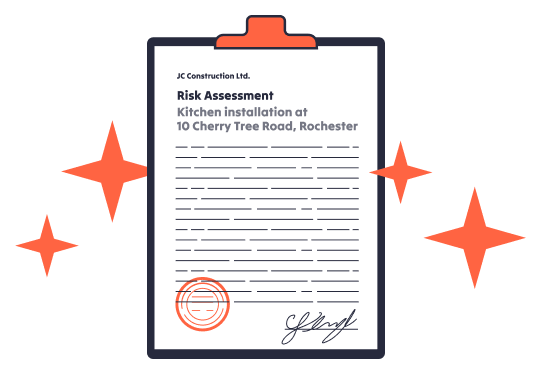
Anyrisks produces a fully written, UK-compliant fire risk assessment following the five-step methodology required by the Fire Safety Order. It includes fire detection, escape routes, fire-fighting equipment, emergency lighting, staff training and maintenance schedules.
3. Instant download and use
Download as PDF and Word. Display it on site, provide it to your insurer, landlord or the fire brigade on request. Update it annually or when your premises change. £29, no subscription, money-back guarantee.
What it covers
Every small business fire risk assessment is written in full — covering all fire hazards, detection systems, escape routes and emergency procedures specific to your premises.
Fire hazards — electrical equipment, cooking, heating, flammable materials
People at risk — employees, customers, contractors, vulnerable persons
Means of escape — exit routes, travel distances, emergency signage
Fire detection and alarm systems — smoke detectors, heat detectors, manual call points
Emergency lighting — escape route illumination, battery backup
Fire-fighting equipment — extinguisher types, locations, servicing requirements
Fire doors and compartmentation — self-closers, seals, fire resistance ratings
Staff training and fire drills — frequency, records, evacuation procedures
Fire safety signage — exit signs, assembly points, fire action notices
Arson prevention — external storage, bins, waste, perimeter security
Dangerous substances (DSEAR) — LPG, solvents, aerosols, oxygen
Maintenance and testing schedules — weekly alarm tests, quarterly emergency lighting tests
Regulatory Reform (Fire Safety) Order 2005 compliance
Review and update schedule — annual review, change management
Works for
From home offices to retail units, Anyrisks covers every type of small business premises in the UK.
What customers say
"Our landlord asked for a fire risk assessment before renewing the lease. Anyrisks produced exactly what we needed — escape routes, extinguisher locations, alarm testing schedule. Done in 5 minutes."
Claire M.
Small business owner, Manchester
"I run a small salon with three chairs. The fire brigade visited as part of a local audit and asked to see our fire risk assessment. Anyrisks covered everything they wanted — staff training, fire exits, extinguisher servicing. No issues raised."
Natasha P.
Salon owner, Bristol
"We have a small office above a shop. The assessment covered both floors, the shared stairwell, and the fact that we sometimes work late. Insurer accepted it without question."
James T.
Office manager, Leeds
Anyrisks vs DIY templates
| Anyrisks | DIY / Templates | |
|---|---|---|
| Written in full — not a blank form | ✓ | ✗ |
| Fire Safety Order 2005 referenced | ✓ | ✗ |
| Five-step methodology included | ✓ | Sometimes |
| Specific to your business type and premises | ✓ | ✗ |
| Covers detection, escape, firefighting equipment | ✓ | Partial |
| Includes staff training and testing schedules | ✓ | ✗ |
| Ready in under 2 minutes | ✓ | ✗ |
| Instant PDF and Word download | ✓ | Sometimes |
Frequently asked questions
Is a fire risk assessment different from my general risk assessment?
Yes — fire risk assessments are required separately under the Regulatory Reform (Fire Safety) Order 2005. Your general workplace risk assessment (required under the Management of Health and Safety at Work Regulations 1999) covers slips, trips, manual handling and other workplace hazards. The fire risk assessment is a dedicated document covering fire detection, escape routes, fire-fighting equipment and emergency procedures. Anyrisks produces both types.
Do I need a fire risk assessment if I work from home?
If you employ anyone who works from your home — even part-time or occasionally — you are the responsible person under the Fire Safety Order and must complete a fire risk assessment. If you are genuinely self-employed with no employees and no public access to your home office, you are not legally required to produce one, but landlords and insurers may request it.
Does this cover retail premises with customers?
Yes — describe your business type (shop, cafe, workshop, office) and whether the public have access. The fire risk assessment will include means of escape for customers, staff training requirements, and fire safety signage. Retail premises with sleeping accommodation above (e.g. flat above shop) require additional fire separation measures — mention this and we will include it.
Can I use this for landlord compliance?
Yes — if you rent out commercial property or a house in multiple occupation (HMO), you are the responsible person and must provide a fire risk assessment. Describe the property type, number of occupants, means of escape and fire detection systems and Anyrisks will produce a compliant fire risk assessment suitable for local authority or tenant requests.
Will this satisfy the fire brigade or building control?
Anyrisks produces a structured, written fire risk assessment in the format expected by fire and rescue services and local authority building control officers. It references the Regulatory Reform (Fire Safety) Order 2005, includes a five-step methodology (identify hazards, identify people at risk, evaluate and reduce risk, record findings, review regularly) and documents control measures. It is accepted across UK enforcement agencies.
How often do I need to review it?
The Fire Safety Order requires that fire risk assessments are reviewed regularly — at least annually, or whenever there is a significant change to the premises, the work carried out, or the people using the building. Anyrisks allows you to generate an updated fire risk assessment at any time for £29. No subscription, no recurring fees.
Does it cover fire extinguisher types and locations?
Yes — describe your premises layout and the fire risks present (cooking, flammable materials, electrical equipment) and the assessment will specify appropriate extinguisher types (water, CO2, foam, powder) and recommended locations. It will also reference the requirement for annual extinguisher servicing under BS 5306.
What if I have employees working alone or out of hours?
Mention that staff work alone or outside normal hours and the fire risk assessment will include lone working fire safety controls — such as ensuring lone workers know escape routes, can raise the alarm, and that fire detection systems are operational 24/7. This is particularly important for cleaners, security staff and shift workers.
How much does a fire risk assessment cost for a small business?
Professional fire risk assessors typically charge £150-£500 depending on the size and complexity of the premises. You can carry out your own fire risk assessment using government guidance at no cost if you have the necessary knowledge, or use an AI tool like Anyrisks to generate a compliant assessment for £29.
Do I need a fire alarm in my small business premises?
Article 8(1)(a) of the Regulatory Reform (Fire Safety) Order 2005 requires adequate measures for detecting and giving warning of fire. For very small, simple premises with quick escape routes, battery smoke alarms may suffice. For premises with multiple rooms, floors, or overnight occupancy, an interlinked fire alarm system is usually necessary.
Can I do my own fire risk assessment or do I need a professional?
The law requires the fire risk assessment to be carried out by a competent person — someone with sufficient training, experience or knowledge. For small, low-risk premises such as offices or shops, the business owner can carry out the assessment after reading government guidance. Higher-risk or complex premises should use a professional assessor.
What are the penalties for not having a fire risk assessment?
Failure to carry out a fire risk assessment is a criminal offence under Article 32 of the RRO 2005. Penalties include fines of up to £5,000 on summary conviction or unlimited fines on indictment, plus up to two years imprisonment. Fire authorities can also issue enforcement notices or close premises immediately if there is serious risk.
What is a responsible person under the RRO 2005?
The responsible person is defined in Article 3 and is typically the employer or business owner. In leased premises, responsibility depends on who has control — tenants are usually responsible for their own areas, landlords for common areas. The responsible person is legally accountable for fire safety compliance.
Give Anyrisks a go today.
You'll be delighted with your fire risk assessment, or your money back.