
Home › Home Office Risk Assessment
Home Office Risk Assessment — DSE Compliance in Minutes
A home office risk assessment identifies ergonomic risks, DSE hazards and mental health factors for employees working from home. Under the Health and Safety (Display Screen Equipment) Regulations 1992, employers must assess home workstations and reduce risks — regardless of who owns the furniture. Describe the home office setup and we'll generate a fully written, DSE-compliant assessment in under 2 minutes.
Used by UK employers, HR managers and health and safety advisers managing home and hybrid workers

💻 Employee using a laptop on a kitchen table? Mention it — we'll include controls for poor posture, screen height, lack of lumbar support and repetitive strain. DSE regulations apply to home workers just as they do to office staff.
Legal requirements for home office risk assessments
The Health and Safety (Display Screen Equipment) Regulations 1992 require employers to assess DSE workstations and reduce risks to the lowest level reasonably practicable. Regulation 2 applies to all employees who habitually use DSE as a significant part of their normal work — including those working from home. The employer's duty does not end at the office door.
Under Regulation 3 of the Management of Health and Safety at Work Regulations 1999, employers must assess risks to employees arising from work activities. For home workers, this includes ergonomic risks from poor desk setup, mental health risks from isolation, and environmental risks such as poor lighting or heating. A written risk assessment is the primary control — it identifies what is wrong and what the employer will do about it.
The HSE's guidance Working with VDUs (INDG36) and Homeworking: Guidance for employers and employees on health and safety make clear that DSE assessments for home workers must be individual and specific. A generic policy is not sufficient — each employee's home workstation must be assessed and documented.
Employers are not required to provide a full office setup at home, but they must take reasonable steps to reduce identified risks. This may mean providing an adjustable chair, external monitor, or keyboard. The assessment records what was found and what action was taken.
How it works
1. Describe the home office setup
Tell us about the desk, chair, monitor position, keyboard type, lighting and room environment. Mention if the employee works full-time or part-time from home, whether they have a dedicated workspace, and any known musculoskeletal issues. If they work entirely alone, mention it and we will include controls for isolation and mental health risks.

2. Let the app take the strain
Anyrisks produces a fully written, DSE-compliant home office risk assessment referencing the Health and Safety (Display Screen Equipment) Regulations 1992 and HSE guidance. Every hazard is identified, every control is written in full.
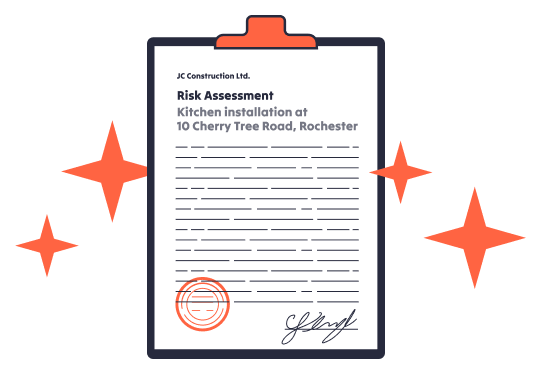
3. Instant download and use
Download as PDF and Word. Share with the employee, file it for HSE inspection, or use it to justify equipment purchases. £29, no subscription, money-back guarantee within 24 hours.
What it covers
Every home office risk assessment is written in full — covering all DSE, ergonomic and mental health risks specific to the employee's home working setup.
DSE hazards — screen height, distance, glare and reflections
Desk and chair ergonomics — adjustability, lumbar support, armrests
Keyboard and mouse position — neutral wrist posture, repetitive strain
Posture and seating position — feet flat, thighs horizontal, back supported
Laptop use — external keyboard, monitor riser, docking station
Lighting and glare — natural light, artificial lighting, window position
Eye strain and screen breaks — 20-20-20 rule, eye tests
Heating and ventilation — room temperature, air quality
Electrical safety — trailing cables, socket overload, PAT testing
Mental health and isolation — lone working, boundaries, regular contact
Work-life balance — dedicated workspace, working hours, breaks
Fire safety — escape routes, smoke alarms, clutter
Manual handling — moving furniture, lifting equipment
Slips, trips and falls — cables, floor condition, stairways
Works for
From full-time remote workers to hybrid staff, Anyrisks covers every type of home office setup.
What customers say
"We've got 40 staff working from home. Anyrisks let me produce individual DSE assessments for each one without spending weeks on it. HR were happy, HSE were satisfied."
Rachel T.
HR Manager, Manchester
"One of our employees was working from a laptop on the sofa. The assessment highlighted the risks and justified the cost of a proper desk and chair. No more back pain complaints."
David K.
Operations Director, Birmingham
"I used it for our hybrid workers who split time between office and home. The assessment covered both locations and was specific enough to satisfy our health and safety audit."
Emma L.
Health and Safety Adviser, Bristol
Anyrisks vs DIY templates
| Anyrisks | DIY / Templates | |
|---|---|---|
| Written in full — not a blank form | ✓ | ✗ |
| DSE Regulations 1992 referenced | ✓ | ✗ |
| Individual and workstation-specific | ✓ | ✗ |
| Covers mental health and isolation risks | ✓ | ✗ |
| Identifies what equipment is needed | ✓ | ✗ |
| Suitable for HSE inspection | ✓ | Sometimes |
| Ready in under 2 minutes | ✓ | ✗ |
| Instant PDF and Word download | ✓ | Sometimes |
Frequently asked questions
Do I need a DSE assessment for every home worker?
Yes — Regulation 2 of the Health and Safety (Display Screen Equipment) Regulations 1992 applies to home workers who habitually use DSE as a significant part of their normal work. Employers must assess workstations and reduce risks, whether the employee works from home or in an office.
What if my employee uses their own desk and chair at home?
The employer's duty under DSE regulations applies regardless of who owns the furniture. If the workstation poses a risk, the employer must take steps to reduce it — this may mean providing an adjustable chair, monitor riser or external keyboard. A home office risk assessment identifies what is needed.
Can I use the same assessment for all home workers?
No — each workstation is different. One employee may work from a dedicated room with proper desk and chair, another from a kitchen table. The DSE assessment must be specific to the individual's setup. Anyrisks allows you to describe the actual workstation and produces a tailored assessment.
Does this cover mental health and isolation risks of home working?
Yes — if you mention that the employee works alone from home full-time, the assessment will include controls for isolation, lack of social contact, and blurred work-life boundaries. These are recognised risks under the Management of Health and Safety at Work Regulations 1999.
Is this accepted by the HSE?
Yes — the assessment is written in the standard format expected by the HSE and references the Health and Safety (Display Screen Equipment) Regulations 1992 and relevant guidance. It is a fully compliant DSE assessment suitable for enforcement inspection.
How long does it take to generate?
Under 2 minutes. Describe the home office setup — desk type, chair, screen position, lighting — and Anyrisks produces a complete DSE-compliant home office risk assessment instantly.
Can I use this for hybrid workers who split time between home and office?
Yes — describe the home working pattern (e.g. 3 days per week) and the assessment will reflect the hybrid arrangement. The DSE regulations apply wherever the employee habitually works, so both home and office workstations should be assessed.
What if the employee has a pre-existing musculoskeletal condition?
Mention any known conditions (e.g. back pain, RSI) and the assessment will include reasonable adjustments and specific controls. Employers have a duty under the Equality Act 2010 to make reasonable adjustments for disabled employees, and this extends to home office setups.
Also see: The Ultimate Guide to Risk Assessment · Do I Need a Risk Assessment? · Risk Assessment Legal Requirements · Risk Assessment Generator