
Home › Working from Home Risk Assessment
Working from Home Risk Assessment — Generated Instantly for £29
UK employers are legally responsible for home workers' health and safety. Describe your employee's home working setup and we generate a fully written, HSE-compliant working from home risk assessment covering DSE, ergonomics, mental health and all relevant regulations in minutes.
Used by UK employers, HR teams and small businesses managing remote and hybrid workers

🏠 Your legal duty doesn't stop at the office door. Whether your employees work from home full-time, part-time or occasionally, you must assess their workstation, provide suitable equipment and manage risks to their physical and mental health.
Your legal duties as an employer
Under the Health and Safety at Work Act 1974, employers must ensure the health, safety and welfare of all employees, wherever they work. This explicitly includes employees working from home. Section 2 of the Act requires you to provide a safe system of work, and this extends to the home office environment.
The Management of Health and Safety at Work Regulations 1999 require all employers with five or more employees to carry out and document a risk assessment. Regulation 3 requires you to assess risks to employees wherever they work, including their homes. This is not optional — it is a legal requirement.
The Health and Safety (Display Screen Equipment) Regulations 1992 apply to anyone who uses a computer screen for an hour or more continuously. This includes home workers. Regulation 2 requires employers to assess DSE workstations and provide suitable equipment, including adjustable chairs, adequate lighting, space and breaks. The HSE has confirmed that these duties apply equally to home workstations.
According to the HSE, employers cannot simply transfer responsibility to the employee. You must assess the home workstation, identify hazards (poor seating, inadequate desk space, glare, isolation) and take action to control the risks. This includes providing equipment, training and regular review.
The rise in home and hybrid working since 2020 has led to increased scrutiny. The HSE expects employers to have documented home working risk assessments for every employee who works remotely regularly. Failure to do so can result in enforcement action, particularly if an employee suffers a work-related injury or ill health at home.
How It Works
1. Describe the Setup
Tell us about the employee's home workspace — room type (bedroom, kitchen, living room), furniture, equipment provided, working hours and whether they work alone all day. Mention any known health conditions (back pain, mental health concerns) that need consideration.

2. Let the app take the strain
Anyrisks produces a fully written, UK-compliant working from home risk assessment covering DSE workstation setup, ergonomics, lighting, mental health, isolation, fire safety and all relevant HSE guidance.
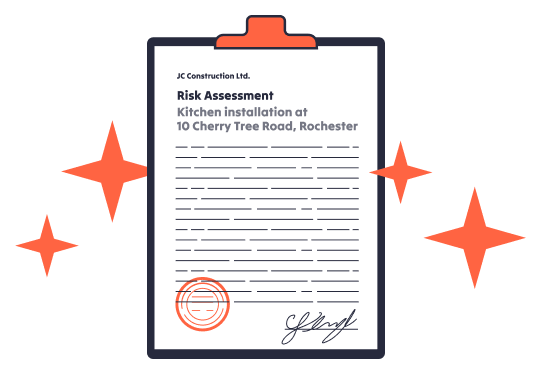
3. Instant Download and Use
Download as PDF and Word. Share with the employee, file it for compliance, or use it as evidence of your legal duty. One assessment per employee. £29, no subscription.
What It Covers
Every working from home risk assessment is written in full — covering all DSE, ergonomic and wellbeing risks specific to your employee's setup.
DSE workstation assessment — chair, desk, screen height and positioning
Ergonomic risks — posture, repetitive strain, musculoskeletal disorders
Lighting and glare — natural light, artificial lighting, screen glare
Space and layout — adequate room to work, trip hazards, storage
Mental health and isolation — loneliness, overwork, work-life boundaries
Electrical safety — trailing cables, socket overload, PAT testing
Fire safety at home — smoke alarms, escape routes, fire extinguishers
Lone working — check-in procedures, emergency contact, communication
Breaks and rest — eye breaks, movement, avoiding prolonged sitting
Equipment provision — chair, monitor, keyboard, mouse, headset
Temperature and ventilation — heating, cooling, air quality
Health and Safety (Display Screen Equipment) Regulations 1992 compliance
Management of Health and Safety at Work Regulations 1999 compliance
Regular review and employee consultation
Works For
From full-time remote roles to occasional home working, Anyrisks covers every home working arrangement.
What Customers Say
"We moved to hybrid working post-pandemic and realised we had no assessments for home workers. Anyrisks let us generate individual assessments for each employee in minutes. Saved us days of admin."
Rachel M.
HR Manager, Bristol
"One of our remote staff reported back pain. We used Anyrisks to assess their setup properly and identified that they were working from a kitchen table with no proper chair. Now compliant and the employee is comfortable."
James T.
Operations Director, Manchester
"As a small business with five staff working remotely, I knew I needed risk assessments but had no idea where to start. Anyrisks made it simple — one assessment per person, all done in an afternoon."
Sophie L.
Small business owner, London
Anyrisks vs DIY Templates
| Anyrisks | DIY / Templates | |
|---|---|---|
| Written in full — not a blank form | ✓ | ✗ |
| Tailored to individual employee's home setup | ✓ | ✗ |
| DSE Regulations 1992 compliance | ✓ | Sometimes |
| Mental health and isolation risks covered | ✓ | ✗ |
| Equipment provision requirements included | ✓ | ✗ |
| Fire and electrical safety at home | ✓ | ✗ |
| Ready in under 2 minutes | ✓ | ✗ |
| Instant PDF and Word download | ✓ | Sometimes |
Frequently Asked Questions
Am I legally required to assess home workers' workstations?
Yes — under the Health and Safety (Display Screen Equipment) Regulations 1992 and the Management of Health and Safety at Work Regulations 1999, employers must assess DSE workstations wherever they are located, including employees' homes. The duty applies regardless of whether the home working is full-time or hybrid.
What if my employee refuses to let me visit their home?
You cannot force entry, but you can require the employee to complete a self-assessment questionnaire and provide photographs of their workspace. Many employers use a combination of self-assessment and video call review. Document the process and any reasonable adjustments offered. If the employee refuses to cooperate, document this refusal clearly.
Do I need to provide home office furniture?
You must ensure the workstation is suitable. If the employee does not have a suitable desk and chair, you must provide them or reimburse the cost. The HSE expects employers to provide at least a suitable chair, and ideally a desk, external keyboard, mouse and monitor for prolonged DSE use.
Does this cover remote workers outside the UK?
This assessment is written for UK home workers under UK health and safety law. If your employees work abroad, different national regulations may apply. Consult local legal advice for employees working from home in other jurisdictions.
Can I use the same assessment for all home workers?
No — each workstation must be assessed individually. Home environments vary significantly (spare bedroom, kitchen table, living room). A generic assessment does not meet the legal requirement. Anyrisks allows you to generate individual assessments quickly for each employee.
What about mental health and isolation risks?
Yes — home working assessments should address mental health, isolation, overwork and lack of boundaries between work and home life. Mention if your employees work alone all day and we will include loneliness and mental health controls, including regular check-ins and access to support.
How often should I review home working risk assessments?
Review annually, or sooner if the employee's circumstances change (new home, different room, health condition, role change). If the employee reports discomfort or musculoskeletal symptoms, reassess immediately.
Does it cover hybrid workers who split time between office and home?
Yes — describe the working pattern (e.g. 3 days home, 2 days office) and we will tailor the assessment accordingly. Hybrid workers face the same DSE and workstation risks at home as full-time remote workers.