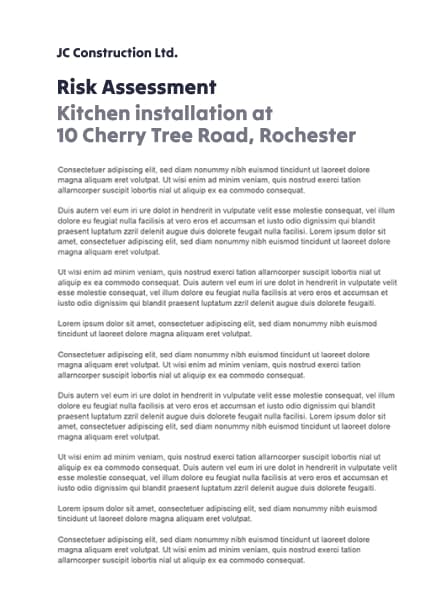
The question ‘does a sole trader need a risk assessment?’ is one of the most searched health and safety queries in the UK — and most of the answers online get it wrong by giving a blanket yes or no. The accurate answer is more nuanced, and understanding it matters: getting it wrong in either direction could expose you to legal liability or unnecessary cost.
The Starting Point: What the Law Actually Says
The primary legal duty for risk assessments sits in Regulation 3(1) of the Management of Health and Safety at Work Regulations 1999 (MHSWR 1999). It states:
“Every employer shall make a suitable and sufficient assessment of — (a) the risks to the health and safety of his employees to which they are exposed whilst they are at work; and (b) the risks to the health and safety of persons not in his employment arising out of or in connection with the conduct by him of his undertaking.”
The key word is employer. MHSWR 1999 Regulation 3 applies to employers — not directly to the self-employed with no employees. This is the source of widespread confusion.
Regulation 3(3) extends a parallel duty to self-employed people, but only in respect of risks to persons not in their employment (i.e. members of the public, other workers on site, clients). If your work could harm someone else, a risk assessment is required regardless of your employment status.
When a Sole Trader Must Carry Out a Risk Assessment
1. If you employ anyone at all
The moment you take on a single employee — including an apprentice, a part-time worker, or a labour-only subcontractor you direct and control — you become an employer under MHSWR 1999 and the full risk assessment duty applies. You must assess risks to that employee and to others affected by your work, and record the significant findings in writing if you have five or more employees under Regulation 3(5).
2. If your work poses risks to others
Even as a genuinely solo operator with no employees, Regulation 3(3) MHSWR 1999 requires you to assess risks to persons not in your employment who may be affected by your work. If you are a sole trader plumber, electrician, or cleaner working in occupied premises, you have a duty to assess the risks your work creates for the building’s occupants and other contractors on site.
3. If you work in a higher-risk prescribed industry
The Health and Safety (Miscellaneous Amendments) Regulations 2002 amended MHSWR to remove an earlier exemption for sole traders in low-risk industries. The practical effect today is that self-employed people whose work activities could foreseeably harm themselves or others are treated as if they were employers for the purposes of health and safety law.
In particular, sole traders in the following industries face additional statutory obligations regardless of whether they employ anyone:
- Construction: The Construction (Design and Management) Regulations 2015 (CDM 2015) apply to all construction work. As a self-employed contractor on a notifiable project, you must cooperate with the principal contractor, comply with the construction phase plan, and ensure your activities do not endanger others on site.
- Gas work: Gas Safe registered engineers are subject to the Gas Safety (Installation and Use) Regulations 1998, which require documented safe working practices and risk-based procedures for every installation or maintenance job.
- Agriculture: The Agriculture (Safety, Health and Welfare Provisions) Act 1956 and subsequent regulations apply specific duties to self-employed agricultural workers.
- Diving operations: The Diving at Work Regulations 1997 impose strict assessment and planning requirements on all diving contractors regardless of size.
When a Sole Trader Does Not Have a Strict Legal Duty
If you are genuinely self-employed with no employees, your work is low-risk, and it could not foreseeably harm any third party, the strict legal duty under MHSWR Regulation 3 does not apply to you. The HSE acknowledges this for activities such as a freelance writer working from home, or a consultant meeting clients in their offices.
However, three important caveats apply even in this scenario:
- Common law duty of care: You owe a duty of care to anyone your work could affect under the law of negligence (Donoghue v Stevenson [1932] AC 562 remains the foundation). A documented risk assessment is your primary evidence that you discharged that duty if a claim arises.
- Contractual requirements: Most principal contractors, commercial clients, and public sector procurement frameworks require written risk assessments and method statements (RAMS) before any contractor starts work, regardless of what the law strictly requires. Without one, you will not get the contract.
- Insurance requirements: Public liability and professional indemnity insurers increasingly require evidence of documented risk management. An absence of any written assessment can void a claim or result in policy cancellation.
The Five-Employee Rule for Written Records
Where a risk assessment is legally required, Regulation 3(5) of MHSWR 1999 requires employers with five or more employees to record the significant findings in writing. Employers with fewer than five employees are still legally required to carry out the assessment — they are simply not required to record it in writing, though the HSE strongly recommends written records for all businesses as proof of compliance.
In practice, if you are a sole trader with one or two employees, you should maintain a written risk assessment. The cost of producing one is negligible; the cost of not having one in the event of an incident or inspection is not.
Practical Implications: What This Means for Sole Traders
According to HSE statistics, self-employed workers account for a significant proportion of workplace fatalities in the UK each year — with construction, agriculture, and maintenance consistently the highest-risk sectors. In 2023/24, the construction industry alone accounted for 51 of the 138 worker fatalities recorded by the HSE.
The practical reality is this: if you work in a trade, on site, or in any environment where your activities could affect the safety of others, you should have a written risk assessment. Not because the law strictly requires it in every case, but because:
- It demonstrates compliance with the general duty of care under the Health and Safety at Work etc. Act 1974 (HSWA 1974)
- It satisfies principal contractor and client requirements
- It protects your insurance position
- It is your primary defence in any enforcement action or civil claim
How to Get a Sole Trader Risk Assessment
Anyrisks generates fully written, UK-compliant risk assessments in under two minutes. Describe your trade, your specific activities, and the location or type of site you work on — and the tool produces a professional document covering your hazards, control measures, and the regulatory requirements relevant to your industry. The output is accepted by principal contractors, commercial clients, and insurers, and is available immediately as both PDF and Word document for £29.