
Home › Construction› Fence & Decking Risk Assessment
Fencing & Fence Installation Risk Assessment — Generated Instantly for £29
Describe the fencing or decking job — materials, site conditions, height, power tools used. We generate a fully written, UK-compliant risk assessment covering manual handling, power tool use, working at height and all relevant regulations in minutes.
Used by landscapers, fencing contractors, decking installers and property maintenance teams across the UK

🪚 Using power tools or working on elevated decking? Mention it — we'll include power tool safety controls, working at height precautions, fall protection measures and the specific controls required under the Work at Height Regulations 2005.
Legal requirements for fencing and decking work
Under the Health and Safety at Work Act 1974, all employers and self-employed contractors must conduct a suitable and sufficient risk assessment for work activities. For fencing and decking installation, this means identifying and controlling hazards including manual handling of heavy timber, power tool use, working at height on elevated decks, ground conditions and underground service strikes.
The Manual Handling Operations Regulations 1992 apply directly to fencing and decking work. Regulation 4 requires employers to avoid hazardous manual handling where reasonably practicable, and where it cannot be avoided, to assess and reduce the risk of injury. Timber fence posts, decking boards and bulk materials present significant manual handling risks that must be documented and controlled.
The Work at Height Regulations 2005 apply to decking installation and elevated fencing work. Regulation 6 requires that work at height is properly planned, appropriately supervised and carried out in a manner that is safe. Even low-level decking (above 2 metres) requires fall protection measures and safe access/egress to be documented in the risk assessment.
The Provision and Use of Work Equipment Regulations 1998 (PUWER) cover the safe use of power tools including circular saws, post drivers, drills and nail guns commonly used in fencing and decking work. A written risk assessment must document how these tools will be used safely, including operator training, guards, PPE and maintenance procedures.
How it works

1. Describe the job
Tell us the type of work (fencing, decking or both), materials, site conditions, height of structures, power tools you'll use and whether you're working alone. If the site has underground services, sloped ground or public access, mention it and we'll include relevant controls.

2. Let the app take the strain
Anyrisks produces a fully written, UK-compliant fence and decking installation risk assessment referencing the Manual Handling Operations Regulations, Work at Height Regulations and PUWER where relevant.
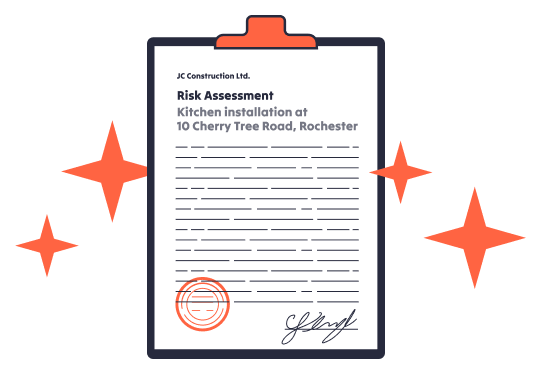
3. Instant download and use
Download as PDF and Word. Hand it to your client, submit it to a main contractor, or file it for compliance purposes. £29, no subscription.
What it covers
Every fence and decking risk assessment is written in full — covering all hazards relevant to your job and site conditions.
Manual handling of timber posts, panels, decking boards and bags of aggregate
Power tool use — circular saws, mitre saws, drills, post drivers, nail guns
Working at height on elevated decking and scaffolding
Fall protection and edge protection for raised decking
Ground conditions — uneven surfaces, slopes, soft ground
Underground service strikes — gas, electric, water cables and pipes
Post hole excavation and confined space risks in deep holes
COSHH — wood preservatives, stains, solvents and treatment chemicals
Slips, trips and falls on site — material storage and housekeeping
Lone working on domestic and commercial sites
Customer property damage prevention and site protection
Noise and vibration from power tools and post drivers
PPE requirements — gloves, safety boots, eye protection, hearing protection
Manual Handling Operations Regulations 1992 compliance
Works for
From domestic garden fencing to commercial decking, Anyrisks covers every type of fencing and decking installation.
What customers say
"I do a lot of domestic decking and fencing. Anyrisks gave me a proper risk assessment covering manual handling, power tools and working at height — ready in 2 minutes. Homeowners are impressed."
Dan R.
Landscape contractor, Hampshire
"We install commercial fencing for schools and parks. The assessment covered underground services, public access and lone working — exactly what we needed for the council contracts."
Claire M.
Fencing contractor, Yorkshire
"I needed a risk assessment for a raised decking job with balustrades. Anyrisks covered fall protection, working at height regs and power tool use — all in one document. Spot on."
Steve L.
Decking specialist, West Midlands
Anyrisks vs DIY templates
| Anyrisks | DIY / Templates | |
|---|---|---|
| Written in full — not a blank form | ✓ | ✗ |
| Manual Handling Operations Regulations referenced | ✓ | ✗ |
| Work at Height Regulations 2005 compliance | ✓ | ✗ |
| Power tool safety and PUWER controls included | ✓ | ✗ |
| Covers both fencing and decking in one document | ✓ | ✗ |
| Underground service strike prevention included | ✓ | ✗ |
| Ready in under 2 minutes | ✓ | ✗ |
| Instant PDF and Word download | ✓ | Sometimes |
Frequently asked questions
Do I need a risk assessment for domestic fencing and decking jobs?
Yes — the Health and Safety at Work Act 1974 requires a risk assessment for all work activities. Fencing and decking involve manual handling, power tools, working at height and ground conditions that present real injury risk. A written risk assessment is expected by homeowners, insurers and the HSE.
Does it cover both fencing and decking in one document?
Yes — describe the full scope of work (fencing, decking, or both) and the assessment will cover all relevant hazards including timber handling, post installation, power tool use, working at height on elevated decking and ground preparation.
What if I am working alone on site?
Mention that you work alone and the assessment will include lone working controls such as check-in procedures, emergency contact details and first aid provisions. Lone working is a specific risk factor in construction work.
Does it cover customer property damage risk?
Yes — controls for protecting customer property, avoiding underground services, safe material storage and post-job site clearance are included where relevant to the job description you provide.
Is it accepted by homeowners and building control?
Anyrisks produces a professional, regulation-referenced risk assessment in the standard format expected by homeowners, building control officers and insurance providers. The document is fully written and ready to use.
How quickly can I get it?
Under 2 minutes. Describe the fencing or decking job and site conditions and Anyrisks generates a complete, UK-compliant risk assessment instantly.
Can I use it for commercial fencing jobs as well?
Yes — whether the job is domestic garden fencing, commercial perimeter fencing or public decking installations, describe the site type and specific risks (height, public access, ground conditions) and the assessment will be tailored accordingly.
Does it cover underground services like gas and electric cables?
Yes — mention underground service risks or use of cable locators and the assessment will include service strike prevention measures in line with HSG47 guidance.
Also see: The ultimate guide to risk assessment · Do I need a risk assessment? · Risk assessment legal requirements · Risk assessment generator