
Home › Kitchen / Bedroom Fitter Risk Assessment
Kitchen / Bedroom Fitter Risk Assessment — Generated Instantly for £29
Describe the fitting job — kitchen, bedroom, property type, whether it is occupied or vacant. We generate a fully written, UK-compliant risk assessment covering manual handling, power tools, dust and site hazards in minutes.
Built for kitchen and bedroom fitters, installation teams and joinery contractors working in domestic homes

🪚 Cutting stone or composite worktops? Mention it — we'll include silica dust controls (water suppression, extraction, RPE) under COSHH 2002, plus the manual handling controls for lifting heavy worktops and carcasses.
Legal requirements for kitchen and bedroom fitters
Under Regulation 3(1) of the Management of Health and Safety at Work Regulations 1999 (MHSWR), every employer and self-employed person must carry out a suitable and sufficient risk assessment of the work they undertake. This applies equally to a one-person fitting business working in a homeowner's kitchen as it does to a large installation team on a new-build site. A written risk assessment is increasingly requested by kitchen retailers, developers and letting agents before booking a fit.
The Manual Handling Operations Regulations 1992 apply directly to this trade — fitters regularly lift and carry heavy carcasses, worktops, appliances and panels, often up narrow domestic staircases. The assessment should identify safer lifting techniques, team lifts and mechanical aids where practical. Where worktops are cut on site, the Control of Substances Hazardous to Health Regulations 2002 (COSHH) requires control of exposure to silica dust and wood dust, both of which carry serious long-term respiratory risks.
Power tools used for cutting, drilling and fixing are covered by the Provision and Use of Work Equipment Regulations 1998 (PUWER), which requires equipment to be suitable, well maintained and used only by competent people. Because most jobs take place inside occupied homes, the assessment should also address safeguarding of residents, children and pets, protection of existing property, and safe access and egress throughout the fit.
How it works

1. Describe the job
Tell us whether it's a kitchen or bedroom fit, whether the property is occupied or vacant, and any specific hazards — worktop cutting, appliance connections, flat access or stairs. If you work alone, mention it and we will include lone working controls.

2. Let the app take the strain
Anyrisks produces a fully written, UK-compliant kitchen and bedroom fitter risk assessment referencing MHSWR 1999, COSHH 2002 and PUWER 1998 where relevant.
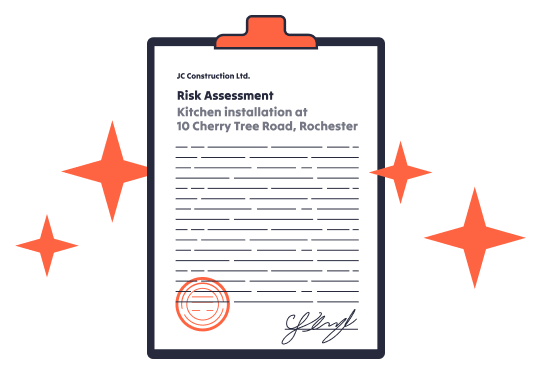
3. Instant download and use
Download as PDF and Word. Hand it to your retailer, developer or client, or file it for your own records. £29, no subscription.
What it covers
Every kitchen and bedroom fitter risk assessment is written in full — covering all hazards relevant to domestic installation work.
Manual handling of carcasses, worktops and appliances
Safe use of power tools — saws, drills, nail guns
Silica and wood dust exposure from cutting worktops and panels
Working in occupied homes — residents, children and pets
Protection of existing flooring, walls and belongings
Isolation of existing electrical and gas supplies before work
Working at height — wall units, cornicing and tall cupboards
Manual handling up stairs and through tight domestic access
Noise exposure from cutting and fixing tools
Slips, trips and falls from offcuts, tools and packaging
Lone working on domestic sites
Fire risk from sawdust accumulation and power tool use
COSHH — adhesives, sealants, varnishes and fillers
Safe disposal of packaging and offcut waste
Works for
From a single bedroom wardrobe fit to a full new-build kitchen package, Anyrisks covers every type of fitting job.
Anyrisks vs DIY templates
| Anyrisks | DIY / Templates | |
|---|---|---|
| Written in full — not a blank form | ✓ | ✗ |
| MHSWR 1999 and COSHH 2002 referenced | ✓ | ✗ |
| Manual handling of carcasses and worktops covered | ✓ | ✗ |
| Occupied home working controls included | ✓ | ✗ |
| Silica and wood dust exposure controls | ✓ | ✗ |
| Covers kitchens, bedrooms and bespoke joinery | ✓ | ✗ |
| Ready in under 2 minutes | ✓ | ✗ |
| Instant PDF and Word download | ✓ | Sometimes |
Frequently asked questions
Also see: The ultimate guide to risk assessment · Do I need a risk assessment · Risk assessment legal requirements · AI risk assessment generator
Do kitchen and bedroom fitters legally need a risk assessment?
Yes. Under Regulation 3(1) of the Management of Health and Safety at Work Regulations 1999 (MHSWR), every self-employed fitter and employer must assess the risks to themselves, their employees and anyone affected by their work, such as homeowners. If you have five or more employees, this assessment must be recorded in writing — but in practice, most main contractors and kitchen retailers will ask sole traders for one too before allowing them on site.
Does this cover working in occupied homes?
Yes. Describe that the job is in an occupied domestic property and the assessment will include controls for working around residents, children and pets, protecting floors and belongings, and managing dust and noise during the fit.
What about power tool and manual handling risks?
These are covered as standard. Fitting kitchens and bedrooms involves significant manual handling of carcasses, worktops and appliances, plus use of saws, drills and nail guns — the assessment references the Manual Handling Operations Regulations 1992 and the Provision and Use of Work Equipment Regulations 1998 (PUWER) where relevant.
Does it include worktop cutting and silica dust?
Yes. If you mention cutting stone, quartz or composite worktops, the assessment will include the specific control of exposure to respirable crystalline silica (RCS) dust under the Control of Substances Hazardous to Health Regulations 2002 (COSHH), including water suppression, on-tool extraction and RPE requirements.
Is gas and electrical connection work covered?
The assessment covers the risks of working near existing gas and electrical supplies, including isolation procedures before disconnecting appliances. It does not replace Gas Safe registration — any final gas connection or electrical certification must still be carried out by a competent, registered engineer.
Can I use this if I am a sole trader with no employees?
Yes. Most kitchen and bedroom fitters are self-employed sole traders. Even without employees, you have a legal duty to manage risks to yourself and others, and a written risk assessment is increasingly requested by retailers, developers and letting agents before work starts.
Is the format accepted by kitchen retailers and developers?
Yes. Anyrisks produces a fully written, regulation-referenced document in the standard format expected by kitchen and bedroom retailers, site managers and property developers who require proof of a risk assessment before booking an installation.
How long does it take to generate?
Under two minutes. Describe the fitting job — kitchen, bedroom, property type and any specific hazards — and Anyrisks produces a complete, UK-compliant risk assessment instantly as PDF and Word.