
Home › Construction › Construction Risk Assessment Template
Construction Risk Assessment Template — Generated Instantly for £29
A construction risk assessment template must be fully written, site-specific, and regulation-compliant to satisfy principal contractors and HSE inspections. Anyrisks generates a complete, UK-compliant construction risk assessment in minutes — covering CDM 2015, working at height, plant operations, and all relevant construction hazards. No blank forms, no guesswork.
Used by builders, contractors, tradespeople and construction managers across the UK

🏗️ Principal contractor RAMS submission? Describe the construction activity, site conditions, and equipment — we'll generate a fully written, CDM-compliant risk assessment that meets contractor approval standards and HSE expectations.
Legal requirements for construction risk assessments
The Construction (Design and Management) Regulations 2015 (CDM 2015) require that all construction work is planned, managed and monitored to ensure health and safety. Regulation 13 places a duty on contractors to plan, manage and monitor construction work, and this includes preparing written risk assessments before work begins. Principal contractors must ensure that all contractors on site have suitable risk assessments in place before mobilising.
Under the Management of Health and Safety at Work Regulations 1999, Regulation 3(1) requires every employer and self-employed person to make a suitable and sufficient risk assessment of the risks to workers and others affected by the work. For construction activities, this means documenting hazards such as working at height, vehicle movement, lifting operations, noise, dust, manual handling, and site-specific risks.
Activity-specific regulations also apply: the Work at Height Regulations 2005 require fall protection measures to be planned and documented; the Lifting Operations and Lifting Equipment Regulations 1998 (LOLER) require safe lifting plans for cranes, hoists and telehandlers; and the Control of Substances Hazardous to Health Regulations 2002 (COSHH) require assessment of construction materials, cement dust, silica and other hazardous substances.
HSE statistics show that construction remains one of the UK's most dangerous industries, with 45 fatal injuries in 2022/23. Principal contractors increasingly require detailed, written construction risk assessments from subcontractors before site access is granted — blank templates and generic checklists are routinely rejected.
How it works

1. Describe the construction activity
Tell us the type of construction work (groundworks, brickwork, roofing, refurbishment, etc.), site type (commercial new build, domestic extension, highway works), equipment and plant in use, and any specific hazards such as working at height, confined spaces, or heavy lifting. If you are working alone or as part of a larger site team, mention it.

2. Let the app take the strain
Anyrisks produces a fully written, UK-compliant construction risk assessment covering all relevant hazards, controls, and legal references including CDM 2015, Work at Height Regulations 2005, LOLER 1998, and MHSWR 1999. No blank forms — every section is written in full.
3. Instant download and use
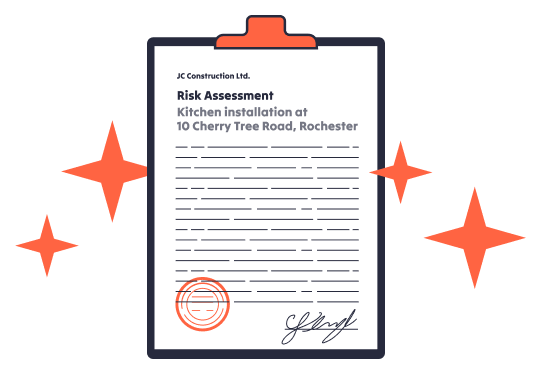
Download as PDF and editable Word document. Submit it to your principal contractor, include it in your RAMS pack, or file it for site induction and HSE compliance. £29, no subscription, money-back guarantee within 24 hours.
What it covers
Every construction risk assessment is written in full — covering all construction hazards and site-specific risks relevant to your project.
Working at height — scaffolding, ladders, MEWPs, roof work
Excavation and groundwork hazards — trench collapse, buried services
Vehicle and plant movement — site traffic, reversing banksmen
Manual handling — heavy materials, repetitive lifting
Lifting operations (LOLER) — cranes, telehandlers, hoists
Noise and vibration — power tools, compaction equipment
Dust and hazardous substances (COSHH) — silica, cement, asbestos
Confined space working — manholes, voids, service ducts
Electrical safety — temporary supplies, 110V tools, overhead cables
Fire risk — hot works, welding, flammable materials on site
Slips, trips and falls — uneven ground, materials storage
CDM 2015 compliance — contractor duties, site coordination
Lone working on small domestic sites
Weather-related risks — wind, rain, heat stress
Works for all construction activities
From groundworks to roofing, Anyrisks covers every type of construction and building work.
What customers say
"I use Anyrisks for every commercial site I go on. The assessments are fully written, reference CDM and all the relevant regs, and they get accepted by principal contractors every time. Saves me hours."
Dan W.
Groundworks contractor, West Midlands
"We were getting blank template forms rejected by site managers. Anyrisks produces a proper, detailed risk assessment that actually describes what we're doing and how we're controlling the risks. Game changer."
Mark T.
Building contractor, Yorkshire
"I do a lot of roofing work — scaffolding, edge protection, working at height. The assessment covered everything and referenced the Work at Height Regulations properly. Principal contractor approved it immediately."
Lee H.
Roofing specialist, South East
Anyrisks vs blank templates
| Anyrisks | Blank Templates | |
|---|---|---|
| Fully written — not a blank form to fill in | ✓ | ✗ |
| CDM 2015 and MHSWR 1999 referenced | ✓ | ✗ |
| Activity-specific regulations included (LOLER, WAH, COSHH) | ✓ | ✗ |
| Covers working at height, plant, lifting, excavation | ✓ | Sometimes |
| Accepted by principal contractors and site managers | ✓ | Often rejected |
| Tailored to your specific construction activity | ✓ | ✗ |
| Ready in under 2 minutes | ✓ | ✗ |
| Instant PDF and editable Word download | ✓ | Sometimes |
Frequently asked questions
Does this replace a RAMS template?
A risk assessment is the core document that identifies hazards and controls. Many contractors also require a method statement — together these form your RAMS pack. Anyrisks produces the risk assessment component. If you describe your working method in detail, the assessment will incorporate it.
Is it compliant with CDM Regulations 2015?
Yes — construction risk assessments reference the Construction (Design and Management) Regulations 2015 where relevant, alongside the Management of Health and Safety at Work Regulations 1999 and activity-specific regulations (LOLER, PUWER, Working at Height, etc.).
Can I use this for multiple sites?
Yes — the assessment covers the activity and common site hazards. You can adapt it for each site by updating site-specific details (site address, site manager, emergency procedures) in the editable Word document.
Will this be accepted by principal contractors?
Anyrisks produces a fully written, regulation-referenced risk assessment in the standard format expected by principal contractors, site managers and the HSE. Thousands of UK construction businesses use Anyrisks assessments on live sites.
Does it cover both commercial and domestic construction?
Yes — describe the project type (domestic extension, commercial new build, refurbishment, etc.) and the assessment will reflect the relevant risks and controls. CDM Regulations apply differently to domestic and commercial projects and the assessment accounts for this.
Can I add my company branding?
Yes — the Word document is fully editable. Add your logo, company details, and site-specific information. The core risk assessment content remains compliant and professionally written.
How long does it take to generate?
Under 2 minutes. Describe the construction activity, site type, and any specific hazards (height, confined spaces, heavy plant, etc.) and Anyrisks produces a complete, regulation-referenced construction risk assessment instantly.
What if I work alone on small domestic jobs?
Mention that you work alone and the assessment will include lone working controls — emergency contacts, check-in procedures, first aid access, and communication requirements under CDM and general health and safety law.
Also see: Construction Risk Assessments · RAMS Template