
Home › Scissor Lift & MEWP Risk Assessment
Scissor Lift & MEWP Risk Assessment — Generated Instantly for £29
Describe the platform type, task and location — indoor warehouse, high street facade, mural work at height. We generate a fully written, UK-compliant scissor lift and MEWP risk assessment covering stabilisation, overhead hazards and public access in minutes.
Used by mural artists, sign fitters, cladding contractors and facilities teams across the UK

🏗️ Working from a scissor lift or MEWP is not the same as working at height on a ladder or scaffold. Mention the platform type and we'll include specific controls for stabilisation, overturning, overhead clearance and public exclusion zones.
Legal requirements for scissor lift and MEWP work
Under Regulation 3(1) of the Management of Health and Safety at Work Regulations 1999, every employer and self-employed person must carry out a suitable and sufficient risk assessment before carrying out work with a mobile elevating work platform. This is a legal duty, not a recommendation — HSE inspectors and site managers routinely ask to see it before allowing a MEWP onto site.
The Work at Height Regulations 2005 require that work at height is properly planned, that equipment is appropriate to the task, and that the risks from falls, overturning and falling objects are managed. The Provision and Use of Work Equipment Regulations 1998 (PUWER) place additional duties on ensuring equipment such as scissor lifts and boom-type MEWPs is suitable, maintained and used only by trained, competent operators.
HSE data consistently shows falls from height remain one of the leading causes of fatal injury to workers in the UK each year, and incidents involving mobile access platforms feature regularly in enforcement notices — most commonly relating to poor ground assessment, incorrect stabilisation, overhead strikes, and inadequate management of public access below the work area. A written risk assessment that addresses these specific hazards is expected by principal contractors, site managers and the HSE.
How it works

1. Describe the job
Tell us the platform type (scissor lift, boom, push-around), the task (mural painting, sign fitting, maintenance), the location (indoor, outdoor, public area) and any specific hazards such as overhead power lines or uneven ground. Not sure whether you even need one? Check do I need a risk assessment.
2. Let the app take the strain
Anyrisks produces a fully written, UK-compliant scissor lift and MEWP risk assessment referencing the Management of Health and Safety at Work Regulations 1999, the Work at Height Regulations 2005 and PUWER 1998 where relevant.
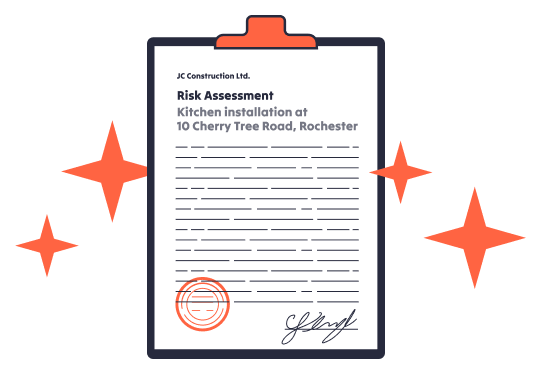
3. Instant download and use
Download as PDF and Word. Hand it to your site manager, client or facilities team, or file it for compliance purposes. £29, no subscription. See the ultimate guide to risk assessment for more background.
What it covers
Every scissor lift and MEWP risk assessment is written in full — covering the hazards specific to elevated platform work.
Ground condition checks and stabilisation before use
Overturning and instability risk, including outriggers and load limits
Overhead hazards — power lines, canopies, signage, tree branches
Falls from the platform — guardrails, harness use and edge protection
Falling objects and drop-zone control below the work area
Public access, pedestrian segregation and exclusion zones
Vehicle and traffic management on street or car park locations
Wind speed limits for outdoor platform work
Operator competence — training, IPAF licence checks and authorisation
Emergency descent and rescue procedures if the platform fails
Pre-use inspection and maintenance checks (PUWER 1998)
Working near building facades — glazing, cladding and structural features
Manual handling of materials and equipment carried on the platform
Communication and banksman/spotter use where visibility is restricted
Works for
From warehouse maintenance to street art, Anyrisks covers every type of scissor lift and MEWP work.
What customers say
"I paint murals from a scissor lift on busy high streets. Anyrisks was the first tool that actually covered pedestrian exclusion zones and overhead shopfront signage — not just generic ladder guidance."
Ellie R.
Mural artist, Bristol
"We hire scissor lifts for warehouse racking jobs across the Midlands. The ground condition and stabilisation section is exactly what our clients ask about before we're allowed on site."
Dave M.
Maintenance contractor, Birmingham
"We use a boom lift for sign installation near roads and car parks. Anyrisks included wind limits, drop-zone barriers and traffic management in one document — saved us hours."
Nasir K.
Sign fitting specialist, Leeds
Anyrisks vs DIY templates
| Anyrisks | DIY / Templates | |
|---|---|---|
| Written in full — not a blank form | ✓ | ✗ |
| Covers stabilisation and overturning risk | ✓ | ✗ |
| Covers overhead hazards specific to platform work | ✓ | ✗ |
| Public access and exclusion zone controls included | ✓ | ✗ |
| Distinguishes scissor lift, boom and push-around risks | ✓ | ✗ |
| References Work at Height Regs 2005 and PUWER 1998 | ✓ | ✗ |
| Ready in under 2 minutes | ✓ | ✗ |
| Instant PDF and Word download | ✓ | Sometimes |
Frequently asked questions
Is a scissor lift or MEWP risk assessment a legal requirement?
Yes — under Regulation 3(1) of the Management of Health and Safety at Work Regulations 1999, every employer and self-employed person must assess the risks to workers and the public before carrying out work with mobile elevating work platforms (MEWPs). The Work at Height Regulations 2005 also require you to plan, supervise and carry out work at height safely, including selecting the right equipment for the task.
Do I need IPAF training as well as a risk assessment?
Yes, they cover different things. IPAF (International Powered Access Federation) certification confirms the operator is competent to use the machine. A risk assessment is a separate legal document that identifies the specific hazards of your job — stabilisation, overhead obstructions, ground conditions, public access — and the controls you will use to manage them. You need both.
Does this cover both scissor lifts and boom-type MEWPs?
Yes — describe the type of platform you are using (scissor lift, articulated boom, telescopic boom, push-around) and the assessment will reflect the specific stability, outreach and overturning risks associated with that equipment.
Can I use this for outdoor jobs like mural painting or sign fitting?
Yes — mention that the work is outdoors, at height, and involves public access (such as mural painting on a building facade or high street signage), and the assessment will include controls for wind speed limits, ground stability, exclusion zones and pedestrian/vehicle segregation.
What does the assessment say about ground conditions and stabilisation?
It covers pre-use ground checks, use of outriggers or stabilisers, permissible ground gradient, load limits on soft or uneven surfaces, and the risk of overturning — all of which must be assessed before a MEWP is positioned, in line with manufacturer guidance and the Provision and Use of Work Equipment Regulations 1998 (PUWER).
Does it cover overhead hazards like power lines and building features?
Yes — overhead hazards including power lines, signage, canopies, tree branches and building overhangs are specifically prompted for, along with minimum safe clearance distances and the use of a banksman or spotter where visibility is limited.
Is this suitable for working near members of the public?
Yes — if your job involves working at height near pedestrians, shoppers or traffic (such as high street or town centre locations), describe this and the assessment will include barriers, exclusion zones, signage and drop-zone controls to protect the public below.
How long does it take to generate?
Under 2 minutes. Describe the platform type, location and task, and Anyrisks produces a complete, regulation-referenced scissor lift/MEWP risk assessment instantly, ready to download as PDF and Word.
Also see: The ultimate guide to risk assessment · Do I need a risk assessment · Risk assessment legal requirements · Risk assessment generator