
Home › Specialist Trades › Chimney Sweeping Risk Assessment
Chimney Sweeping Risk Assessment — Generated Instantly for £29
Describe the chimney type, access method, property and any specific hazards. We generate a fully written, UK-compliant chimney sweeping risk assessment covering working at height, confined spaces, soot exposure and all relevant regulations in minutes.
Used by self-employed chimney sweeps, sweeping businesses and heritage property contractors across the UK

🪜 Working on ladders or accessing roofs? Mention it — we'll include ladder safety controls under the Work at Height Regulations 2005, weather risk assessments, and fall prevention measures tailored to chimney access.
Legal requirements for chimney sweeps
Chimney sweeping involves unique hazards that require specific legal compliance. A written risk assessment is required under the Management of Health and Safety at Work Regulations 1999 (Regulation 3) for every job, whether you are self-employed or employ others. This applies to domestic, commercial and heritage properties.
The Work at Height Regulations 2005 apply to all chimney sweeps who use ladders or access roofs. Regulation 4 requires that work at height is properly planned, supervised and carried out by competent persons, with equipment inspected before use. Falls from ladders are a leading cause of injury in the trade — the HSE recorded over 4,000 ladder-related injuries across all industries in 2022/23.
Chimney sweeps working inside flues or chimney structures must comply with the Confined Spaces Regulations 1997, which require a written safe system of work, gas monitoring, emergency rescue arrangements and competent supervision. Even brief entry into a flue qualifies as confined space work.
The Control of Substances Hazardous to Health Regulations 2002 (COSHH) apply to soot, coal dust, creosote and other respiratory hazards. Regulation 7 requires that exposure is prevented or adequately controlled, typically through RPE (respiratory protective equipment), vacuum extraction and dust suppression. Long-term exposure to soot and coal dust is linked to respiratory disease.
How it works

1. Describe the job
Tell us the chimney type (open fire, wood burner, coal, oil, gas), property type (domestic, pub, restaurant, heritage building), access method (ladder, roof access, scaffolding), and any specific hazards such as hot flues, confined space entry or structural issues. If you work alone on site, mention it and we will include lone working controls.

2. Let the app take the strain
Anyrisks produces a fully written, UK-compliant chimney sweeping risk assessment referencing the Work at Height Regulations 2005, Confined Spaces Regulations 1997, COSHH and all relevant legislation.
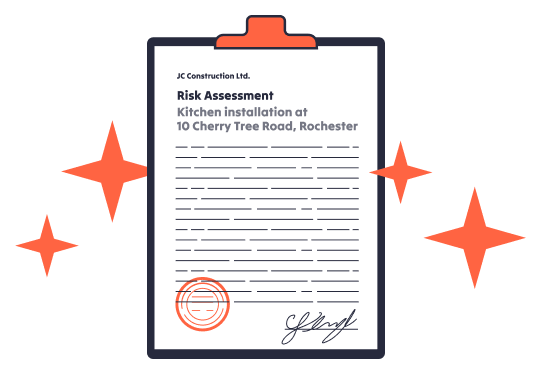
3. Instant download and use
Download as PDF and Word. Hand it to your client, include it in your compliance documentation, or file it for inspection purposes. £29, no subscription, money-back guarantee.
What it covers
Every chimney sweeping risk assessment is written in full — covering all access, respiratory and site hazards relevant to your job.
Working at height — ladder safety, roof access, fall prevention
Work at Height Regulations 2005 compliance
Confined space entry into flues and chimney structures
Confined Spaces Regulations 1997 compliance
Soot, coal dust and creosote exposure — COSHH controls
Respiratory protective equipment (RPE) — masks, filters, fit testing
Hot surfaces and burn risk from recently used flues
Manual handling of brushes, rods, vacuum equipment and soot sacks
Structural hazards — unstable chimneys, loose bricks, historical buildings
Lone working in domestic and commercial properties
Vehicle safety — transporting ladders and equipment
Fire risk from sparks, embers and flammable soot deposits
Weather conditions — wind, rain, ice affecting ladder and roof work
Client property protection — dust sheets, vacuum containment
Works for
From domestic open fires to commercial wood burners and heritage properties, Anyrisks covers every type of chimney sweeping work.
What customers say
"I sweep a lot of heritage properties and National Trust sites. They all want risk assessments now. Anyrisks covered ladder safety, confined space working and soot exposure — everything I needed in one document."
David R.
Self-employed chimney sweep, Cotswolds
"I work alone and clients always ask about lone working controls. Anyrisks included check-in procedures, emergency contacts and access arrangements — all regulation-referenced and professional."
Tom H.
Sole trader chimney sweep, Yorkshire
"We do a lot of commercial work — pubs, restaurants, hotels. Every site now needs a risk assessment before we start. Anyrisks saved us hours and the assessments are accepted every time."
Claire M.
Chimney sweeping business, South East
Anyrisks vs DIY templates
| Anyrisks | DIY / Templates | |
|---|---|---|
| Written in full — not a blank form | ✓ | ✗ |
| Work at Height Regulations 2005 referenced | ✓ | ✗ |
| Confined Spaces Regulations 1997 compliance | ✓ | ✗ |
| COSHH controls for soot and dust exposure | ✓ | ✗ |
| Ladder safety and fall prevention included | ✓ | ✗ |
| Hot surface and burn risk controls | ✓ | ✗ |
| Covers domestic, commercial and heritage properties | ✓ | ✗ |
| Ready in under 2 minutes | ✓ | ✗ |
| Instant PDF and Word download | ✓ | Sometimes |
Frequently asked questions
Do chimney sweeps legally need a risk assessment?
Yes — under the Health and Safety at Work Act 1974 and the Management of Health and Safety at Work Regulations 1999, every self-employed chimney sweep and sweeping business must complete a written risk assessment for every job. This applies equally to sole traders and companies. The risk assessment must cover working at height, confined space entry, soot and dust exposure, hot surfaces, and any site-specific hazards.
Does it cover working at height on ladders and roofs?
Yes — describe how you access the chimney (ladder, scaffolding, roof access) and the assessment will include controls for working at height under the Work at Height Regulations 2005, including ladder safety, fall prevention, and weather conditions.
What about soot and dust exposure — is COSHH covered?
Yes — chimney sweeps are exposed to soot, coal dust, creosote and other respiratory hazards. The assessment includes COSHH controls under the Control of Substances Hazardous to Health Regulations 2002, specifying RPE (respiratory protective equipment), vacuum systems, and dust suppression measures.
Can I use it for both domestic and commercial properties?
Yes — describe the property type (domestic home, pub, restaurant, historical building, industrial premises) and the assessment will be tailored accordingly. Commercial and heritage chimneys often have additional access and structural considerations.
Does it cover working in confined spaces inside chimneys?
Yes — if you enter the flue or work inside the chimney structure, mention this and the assessment will include confined space controls under the Confined Spaces Regulations 1997, including gas monitoring, ventilation, and emergency rescue procedures.
Is the assessment accepted by building owners and insurance companies?
Yes — Anyrisks produces a fully written, regulation-referenced risk assessment in the standard format expected by building owners, facilities managers, heritage organisations, and insurance providers. It is professional, specific and compliance-ready.
Does it cover hot flues and burn risks?
Yes — working on recently used chimneys presents burn and heat stress risks. Describe the flue condition (recently used, hot, cold) and the assessment will include controls for hot surface contact, heat exposure and appropriate PPE.
How long does it take to generate?
Under 2 minutes. Describe the chimney type, access method, property type and any specific hazards, and Anyrisks produces a complete, UK-compliant chimney sweeping risk assessment instantly.
Also see: The ultimate guide to risk assessment · Do I need a risk assessment? · Risk assessment legal requirements · Risk assessment generator